

Band Scores Explained: What Each Score Really Means
IELTS band scores are based on official band descriptors. By understanding what a Band 6, 7, or 8 actually require allows students to see real improvements in their success.
This page explains what each band really means.
HOW IELTS BAND SCORES WORK
IELTS doesn’t give one score for your English — it averages your four skill scores to produce your final band.
Each skill is scored from 0–9 and marked with it's own criteria.
The overall band is the average of the four skills.
The average is rounded to the nearest 0.5.
-
6.25 → 6.5
-
6.13 → 6.0
Example IELTS scores and overall band
.png)
IELTS Band Scores Described
Band descriptors describe the level of language expected at each IELTS band score. They explain the features examiners look for when assessing performance in the exam.
Different universities, employers, and immigration authorities require different band scores, so it is always important to check the specific requirements for your situation.
.jpg)

.jpg)
IELTS Reading: Academic and General
Raw Scores and Band Conversions
In IELTS Reading, band scores are based on the number of correct answers out of 40 and then converted to a band score using official tables.
Academic and General Training use different conversions because the texts differ in difficulty with the Academic being more complex.
.jpg)
IELTS Listening: Academic and General
Raw Scores and Band Conversions
In IELTS Listening, band scores are based on the number of correct answers out of 40 and then converted to a band score using official tables.
Unlike Reading, the Listening test is the same for both Academic and General Training.
IELTS Writing band scores: Academic and General Training
In IELTS Writing, Academic and General Training are assessed using the same band descriptors.
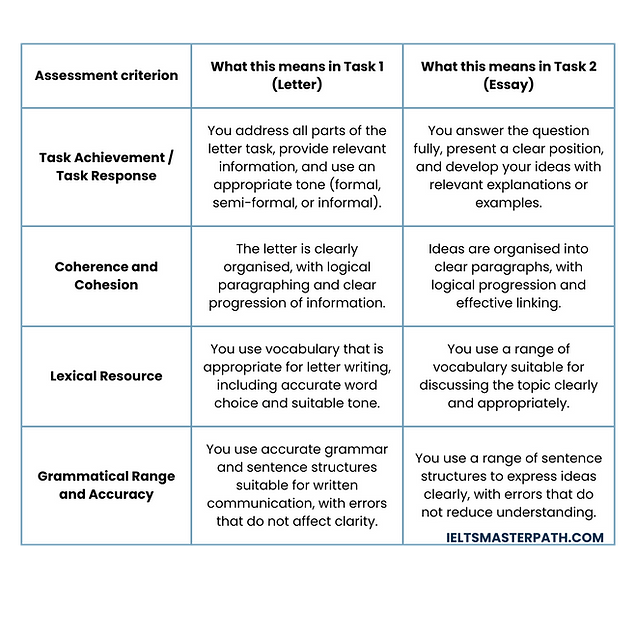
The IELTS Writing test has two tasks. An examiner assesses both tasks using four criteria. Each criterion is scored separately and carries equal weight - 25% each.
The four scores are then averaged for the final IELTS Writing band score.
The four assessment criteria are:
-
How well you answer the task (Task Achievement / Task Response)
-
How clearly your ideas are organised and linked (Coherence and Cohesion)
-
How accurately and effectively you use vocabulary (Lexical Resource)
-
How well you use grammar and sentence structures (Grammatical Range and Accuracy)
General Writing
.png)
What the Writing Criteria Means
Academic Writing
.png)
IELTS Speaking band scores: Academic and General Training
In IELTS Speaking, the same four band descriptors are used for all three parts of the test and for both Academic and General Training. While the criteria are the same, the focus changes across Parts 1, 2, and 3 as candidates move from short, personal responses to longer, more developed and abstract discussion.
The four scores are then averaged to produce the final IELTS Speaking band score. Speaking is assessed using four criteria:
-
How fluently and clearly you speak (Fluency and Coherence)
-
How accurately and effectively you use vocabulary (Lexical Resource)
-
How well you use grammar and sentence structures (Grammatical Range and Accuracy)
-
How clear your pronunciation is (Pronunciation)
What the Speaking Criteria Means
.png)
Understanding what IELTS band scores mean provides a clear framework for interpreting exam results and setting realistic goals. By knowing how scores are defined and assessed, it becomes easier to understand current performance and identify what may need further attention.
For answers to common questions about IELTS scores, retakes, and test options, see our IELTS FAQs.